
Telecom expertise
Built by telecom billing professionals, TimelyBill is designed to handle the complexity of billing, invoicing, and customer management across real-world telecom environments.
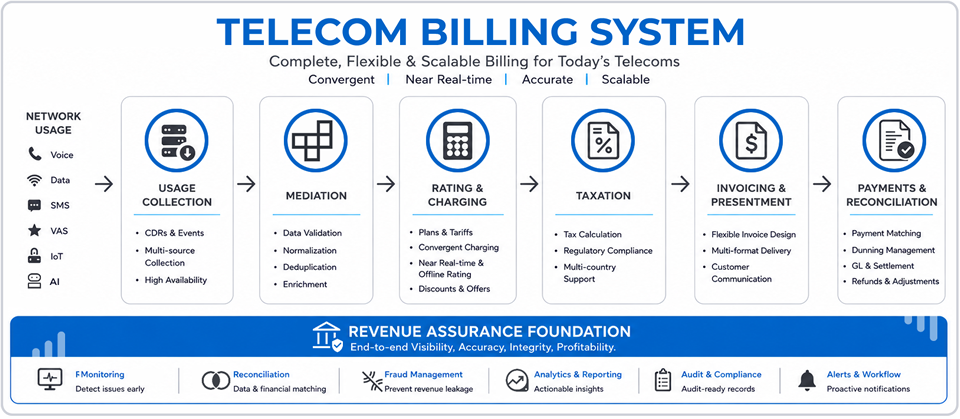
Billing management, invoicing, and revenue assurance are often spoken about as separate functions. In reality, they are parts of the same process. Telecom billing is the full system. Invoicing is a single step within it. Revenue assurance is the control layer that verifies the output is complete, accurate, and defensible. Modern telecom billing begins with the collection of usage events and ends with an invoice presented to customers.
Telecom billing is not just subscription billing
Subscription billing usually starts with a fixed recurring price. Telecom billing often starts with usage—calls, sessions, messages, bytes, routes, destinations, trunks, features, and service events—each governed by its own pricing logic. Many providers also sell bundles that mix one-time, recurring, and usage-based charges.
Before a single invoice exists, providers must ingest high-volume usage data from multiple sources, normalize inconsistent records, apply complex rating logic, classify services correctly for taxation, and reconcile everything into a single auditable result. When any step in that chain breaks, revenue leaks.
Why usage, rating, and taxation make telecom billing hard
The hard part isn’t creating an invoice. The hard part is maintaining a reliable chain from raw network events to billable charges:
The cost of getting telecom billing wrong
Billing gaps compound quietly: revenue leakage, disputes, credits, delayed close, and operational drag. The longer a flawed billing process runs, the harder it becomes to correct without customer impact.
Many emerging providers try to force telecom products into generic subscription or payment platforms. It works for the first 50-100 customers. Then usage grows, suppliers multiply, tax exposure expands, and billing becomes a monthly chore.
Generic platforms see a simple subscription. Telecom billing systems see a dynamic usage envelope. Billing for time, distance, destinations, packets, origination, termination, and service context, often calculated to the sixth decimal place.
In telecom, billing data isn't just math. Every usage record represents time, distance, bandwidth, or access that must be accounted for. Lose a record, corrupt a field, or misclassify a service, and the result is either lost revenue or regulatory exposure. That's why we treat telecom billing as a strict Usage-to-Cash Chain of Custody.
Usage data arrives from switches, platforms, and suppliers in mixed formats: CSV, XML, APIs, and proprietary exports. If a system can't automatically validate and heal malformed records, billing doesn't just slow down, it stops.
Rating applies tiers, bundles, minimums, time-of-day rules, destination logic, and supplier-specific pricing. This is where margin is either protected, or eroded.
Telecom taxation depends on correct service classification and accurate location data. Misclassification often goes unnoticed until audits or customer disputes surface.
Invoicing is the final custody transfer. By the time an invoice is generated, the billing charges should already be settled.
A telecom billing platform should support recurring, non-recurring, usage-based, tiered, bundled, and hybrid pricing without forcing workarounds.
Telecom taxation needs consistent service classification, accurate location data, and auditable reports.
Many CSPs resell services from multiple suppliers while managing their own customer relationships. The billing challenge is producing a single consolidated invoice while importing usage and applying the correct taxes.
A practical telecom billing system automates usage imports, rates usage consistently, and delivers unified invoice presentment that combines recurring and usage charges across suppliers.
Modern providers often run more than one line of business—VoIP, UCaaS, wireless, IoT, and subscription services. A convergent product catalog and flexible rating logic prevent providers from maintaining separate billing stacks.
Telecom billing is the process of converting service usage and subscription charges into accurate invoices, including pricing rules, taxes, adjustments, and invoice presentation customers can understand.
CDR rating applies pricing rules to call detail records (CDRs) to calculate billable charges. Rating can include time bands, destinations, rounding rules, tiers, bundles, and supplier-specific pricing.
Unified invoicing requires usage imports from each supplier, consistent rating logic, tax handling, and invoice assembly so customers receive a single consolidated invoice rather than multiple statements.
Disputes often come from unclear invoice presentation, missing charge context, inconsistent taxes, or timing differences between systems. Clarity and auditability reduce disputes as much as accuracy does.
Common causes include missing usage imports, incorrect rating tables, misclassified services for tax, manual adjustments without controls, and disconnected provisioning/billing processes.
TimelyBill is designed for communications service providers that need billing to work across products, usage, taxes, partners, and customer operations—not just produce invoices.
Built by telecom billing professionals, TimelyBill is designed to handle the complexity of billing, invoicing, and customer management across real-world telecom environments.
We work closely with service providers to adapt billing workflows as products, usage models, and regulations evolve.